

Building a brand community sounds simple in theory. You gather people who like your business, give them a place to connect, and let conversations grow. In practice, many brands struggle because they treat community like an audience list instead of a living space. A real community is not just a follower count or a comment section. It is a place where people return because they feel involved, recognized, and connected.
That is why starting a community around your brand requires more than posting updates and hoping people participate. You need a clear purpose, the right platform, a structure that encourages engagement, and a system for turning passive readers or customers into active members.
For website owners, creators, membership businesses, and course builders, this matters more than ever. Social media platforms can change algorithms overnight. Facebook Groups are crowded and limited. Discord can feel chaotic for many brand communities. Hosted platforms like Mighty Networks and Circle can work, but they often come with ongoing platform dependence and less flexibility than a WordPress-based solution.
If you want full ownership, strong social features, and direct integration with your website, PeepSo is one of the most practical ways to build a branded community on WordPress. It gives you member profiles, activity streams, messaging, groups, and notifications without forcing your business to live on someone else’s platform.
Why building a brand community?
A strong community can do what ordinary marketing cannot. It creates repeated interaction between your brand and the people who care about it. Instead of always trying to attract new attention, you build a space where members keep coming back.
This has several long-term benefits. It increases retention because members become part of something larger than a purchase. It improves customer insight because you hear real conversations and questions. It strengthens trust because people see others participating, sharing experiences, and helping each other. It also creates momentum because community members often become your most loyal advocates.
A brand community can support many business goals. It can help onboard new customers, support paid memberships, improve customer education, reduce support burden, create networking opportunities, or simply deepen audience loyalty. The key is to decide what role your community will play before you launch it.
Start with a clear community purpose
One of the biggest mistakes brands make is launching a community with no clear reason for members to join. If the only purpose is to talk about your brand, most people will lose interest quickly. Members usually join communities to solve a problem, learn something useful, meet others like them, or get access they cannot find elsewhere.
Before setting up any platform, define the core purpose of the community. Ask yourself what transformation or value members will gain by participating regularly.
Common brand community purposes
A community usually works best when it centers on one of these models:
- Support and education
- Peer networking
- Shared interest or identity
- Customer success and retention
- Exclusive membership access
- Creator or course-based engagement
For example, a fitness brand might build a community around accountability and progress sharing. A software company might focus on user education and peer support. A course creator might build a private member space for lessons, discussion, and direct interaction.
When the purpose is clear, the rest becomes easier. Your content, onboarding, groups, posts, and moderation all become more focused.
Define your ideal member
You also need to know exactly who the community is for. A community that tries to serve everyone usually feels vague and inactive. Be specific. Think about the member’s stage, goals, frustrations, and reasons for joining.
A better approach is to describe one core member type in plain language. For example, “website owners who want to build a paid community on WordPress” is much stronger than “entrepreneurs interested in online growth.”
This clarity helps you create more relevant conversations and attract people who are more likely to participate.
Choose a platform you actually control
Where you build your community shapes how it grows. Many brands start inside Facebook Groups because it feels easy. The problem is that you do not own the environment, the experience, or the data. Your members are still on Facebook, surrounded by distractions and other brands. The same issue appears in different ways with Discord and some hosted community tools.
If your community is important to your business, it should live on your website, under your brand, with your rules.
That is where PeepSo stands out. Instead of sending your members to a third-party platform, you build the experience directly into WordPress. Your community becomes part of your site, not a separate service your audience has to adapt to.
Why PeepSo is a strong fit for brand communities
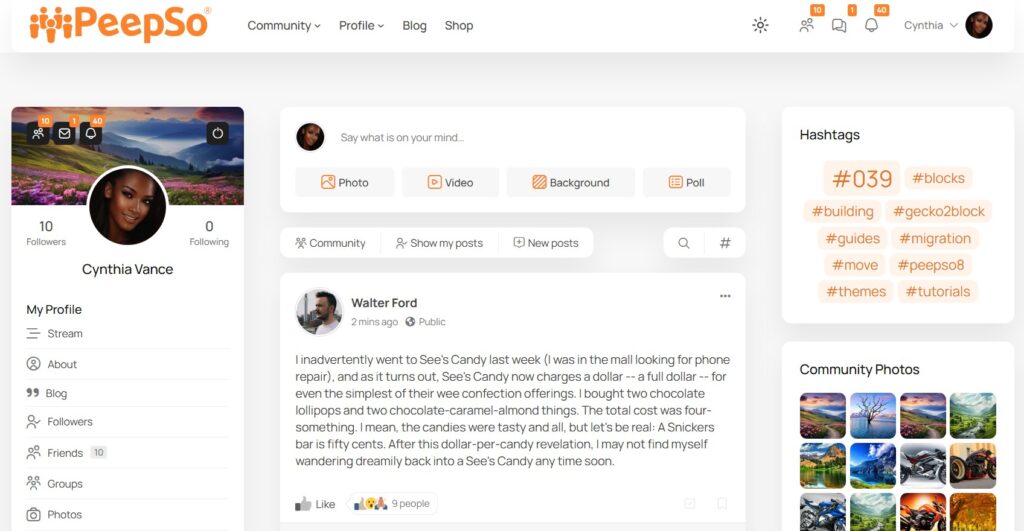
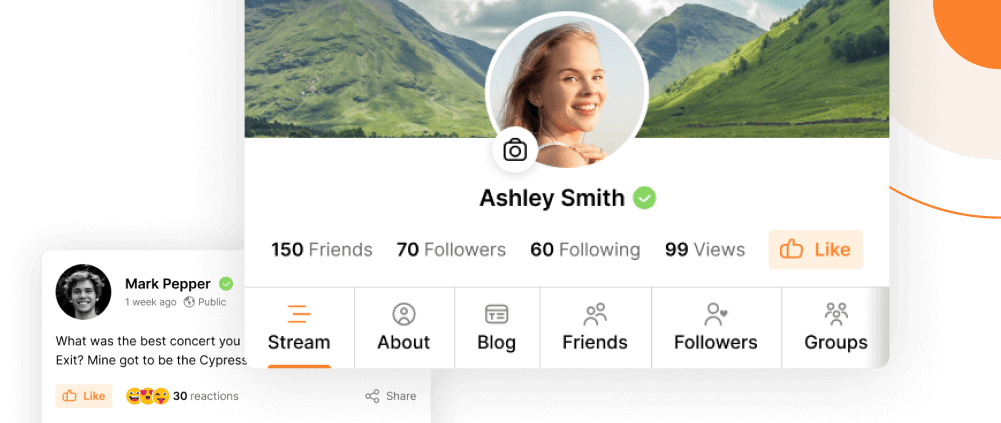
PeepSo works especially well for businesses that want to combine content, membership, and social interaction in one place. You can create a full branded community experience using features such as:
- Member profiles
- Activity streams
- Private messaging
- Groups
- Notifications
- Media sharing
- Custom registration flows
Compared with Facebook Groups, you get ownership and branding control. Compared with Discord, you get a more structured and approachable member experience for non-technical audiences. Compared with Mighty Networks or Circle, you keep your community inside WordPress and connected to the rest of your website. Compared with BuddyPress, many site owners find PeepSo more polished and practical out of the box.
Build the structure before you invite people in
A community should not feel empty on day one. Even the best members will hesitate if they arrive and see no conversations, no guidance, and no signs of activity. Before inviting people in, build a basic structure that makes the space feel active and easy to use.
Create essential sections
Your exact structure will depend on your business, but most communities benefit from a few foundational areas:
Welcome area
This is where new members introduce themselves, learn the rules, and understand how to get started. It should feel friendly and clear.
General discussion (Activity Stream)
This is the main shared space for ongoing conversation. It gives members somewhere to post even when they are unsure where something belongs.
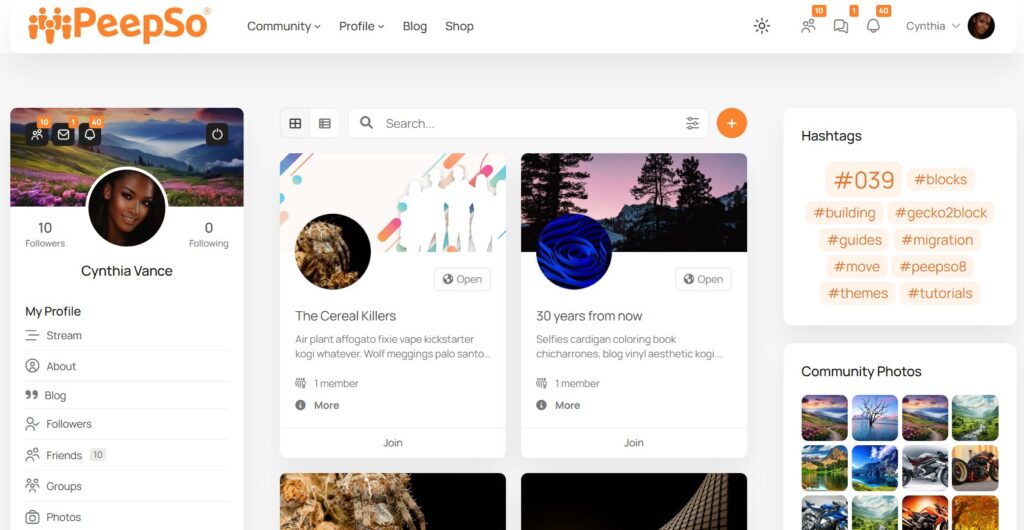
Topic-based groups
Groups help organize conversation around interests, goals, product categories, or member segments. This is especially valuable as your community grows.
Resource or support area
A support-focused community can include discussion around common questions, tutorials, or member help. A creator community might use this area for lesson discussion or implementation help.
With PeepSo, groups and activity streams make this structure easier to manage. Members can interact broadly in the main stream or go deeper inside focused groups.
Seed the first conversations
Do not launch with a blank feed. Add welcome posts, discussions, useful resources, and a few member-style posts from your team. Seed at least 10 to 20 useful interactions so the space feels alive.
Examples include:
- A welcome thread with an introduction instructions
- A “start here” post
- A member success story
- A common question and answer
- A weekly discussions
- A feedback request
- A useful how-to resource
This gives new members something to respond to immediately.
Give members a reason to participate
A community grows when people feel there is value in showing up. That value can come from information, visibility, belonging, access, or progress. The more clearly you offer it, the easier engagement becomes.
Focus on member benefit, not brand broadcasting
Many businesses accidentally treat their community like a one-way marketing channel. They post announcements, promotions, and updates, but leave little room for real member interaction. This usually leads to low engagement.
A stronger community model is built around member contribution. Your brand should guide the space, but members should help shape the experience. Encourage questions, peer advice, shared wins, and practical discussion. When members learn from each other, the community becomes much more valuable.
Create repeatable engagement formats
People participate more often when they know what kind of content to expect. Repeatable formats remove friction and make it easier to contribute.
Examples include:
- Monday goal setting
- Wednesday wins
- Friday feedback threads
- Monthly live Q&A discussions
- New member introductions
- Community challenges
- Expert spotlight posts
These formats create rhythm. Instead of wondering what to post, members recognize familiar topics and join in.
Reward useful participation
Not every reward has to be financial. Many communities grow through simple recognition. Highlight helpful members. Feature good posts. Respond quickly to introductions. Thank members who contribute often.
PeepSo’s notifications, profiles, and social interaction features help reinforce these moments. Members feel seen when their participation receives visible responses.

PeepSo Power Suite

Onboard new members carefully
Strong onboarding can make the difference between a member who disappears and one who becomes active. Most people need a nudge before they participate. They want to know where to start, what to do next, and how the community helps them.
What good onboarding includes
A simple community onboarding flow should answer four questions:
- Why am I here?
- What should I do first?
- Where do I go for the most relevant conversations?
- How do I get value quickly?
Your welcome experience might include a pinned post, a short guide, an email sequence, and a simple first action such as introducing themselves or joining a relevant group.
This is another advantage of running your community on WordPress with PeepSo. You can connect registration, onboarding pages, member roles, and content access into one system instead of trying to patch together separate services.
Make the first action easy
Do not ask new members to do too much. Give them one simple first step. Good examples include:
- Introduce yourself and share your goal
- Complete your member profile
- Join one relevant group
- Answer a welcome poll
- Comment on a current discussion
These small actions reduce hesitation and help members move from observer to participant.
Establish simple rules and active moderation
Every healthy community needs boundaries. Rules do not make a community less friendly. They make it safer and more useful.
Your rules should be short, clear, and aligned with the purpose of the space. Focus on respectful behavior, relevance, self-promotion limits, and privacy expectations. A complicated policy page is less helpful than a few practical standards members can understand quickly.
Moderation matters just as much as the rules themselves. Members pay attention to what is allowed, what gets encouraged, and how problems are handled. If spam, hostility, or off-topic posting goes unchecked, engagement usually drops.
As the community owner, your goal is not to control every conversation. It is to protect the quality of the space. That means welcoming good participation, redirecting unclear posts, and handling issues consistently.
Connect the community to your broader brand ecosystem
A community should not exist in isolation. It should strengthen the rest of your business.
That can mean using the community to support customers after purchase, extend the value of a course, deepen member retention, or create a stronger content ecosystem around your brand. When your website, email strategy, products, and community work together, each part becomes more useful.
Practical integration ideas
You can connect your community to your brand in several ways:
- Invite customers after checkout
- Link blog posts to relevant group discussions
- Host member-only resources inside the community
- Use community questions to inspire content
- Offer premium access tiers for deeper participation
- Encourage testimonials and case study sharing from active members
PeepSo fits well here because it is part of WordPress. Your content site, membership setup, store, and community can live in the same ecosystem. That is much harder to achieve when your community lives entirely on an external platform.
Measure what makes the community healthy
A growing community is not just about total signups. The more important question is whether members are returning, participating, and getting value.
Look at metrics that reflect health, not vanity. Useful community indicators include active members, posts per member, response rate, return visits, group participation, and onboarding completion. You should also pay attention to qualitative signs such as stronger conversations, member-to-member support, and repeated engagement from the same people.
Early on, your goal is not scale. It is consistency. A smaller community with regular useful conversation is much more valuable than a large community where nobody posts.
Common mistakes to avoid
Many brand communities struggle for predictable reasons. The good news is that these problems are avoidable.
One common mistake is launching too early with no structure. Another is attracting members with no clear shared purpose. Some brands post too much promotional content and leave little room for member discussion. Others fail to onboard new members or stop participating themselves after launch.
A community also fails when the platform creates friction. If the experience feels disconnected from your website, hard to navigate, or too dependent on a third-party environment, members are less likely to build long-term habits there.
That is why an owned platform matters so much. PeepSo gives brands a practical way to avoid this trap by keeping the experience under their control while still providing the social features members expect.
Conclusion
Starting a community around your brand is not about opening a discussion space and hoping people show up. It is about creating a useful environment where the right members can connect around a shared purpose.
The brands that succeed with community usually do a few things well. They define a clear reason for the community to exist. They choose a platform they control. They structure the space before launch. They onboard members intentionally. They create repeatable engagement habits. And they treat the community as part of the broader business, not as a side project.
For WordPress site owners, PeepSo is one of the best practical ways to do this. It keeps your community on your own platform and gives you the features that matter most, including member profiles, activity streams, messaging, groups, and notifications. That combination makes it much easier to build a branded community that people actually want to return to.
A strong community does not appear overnight. But with the right purpose, structure, and platform, it becomes one of the most valuable assets your brand can own.


Reactions & comments
Comments