

If you are comparing BuddyPress and PeepSo, the obvious difference is price. BuddyPress is free. PeepSo has a free foundation and PeepSo Free Bundle as well as paid bundles for more advanced features.
That is the easy comparison. It is also the least useful one. The real question is not “Which plugin costs less on day one?” The real question is: which one gives you a community you can actually launch, maintain, grow, and trust over time?
That is where the comparison changes quickly.BuddyPress deserves respect. It has been part of the WordPress ecosystem for a long time, it is open source, and it helped define what a self-hosted WordPress community could be. For developers who want a flexible foundation and are comfortable assembling their own stack, BuddyPress can still be useful.
But for most site owners, membership businesses, creators, educators, private networks, and community builders, BuddyPress is no longer the stronger practical choice. It is too dependent on a fragmented third-party ecosystem, too inconsistent from feature to feature, and too often pushes site owners into old add-ons that may not be properly maintained.
PeepSo comes out on top because it is built as a product, not a scavenger hunt.
Quick Verdict
Choose BuddyPress if you want a free, developer-oriented framework and you are comfortable researching, testing, styling, debugging, and maintaining a stack of third-party plugins. Choose PeepSo if you want a modern WordPress community plugin with user profiles, activity streams, groups, media, chat, pages, integrations, direct support, and regular product updates from one team.
Already on BuddyPress? You do not have to start from scratch. PeepSo provides a BuddyPress to PeepSo migrator, so existing communities have a practical path away from the old plugin stack and into a maintained PeepSo setup. For a serious community in 2026, PeepSo is the better choice.
Comparison at a Glance
| Area | BuddyPress | PeepSo | Winner |
|---|---|---|---|
| Core update cadence | WordPress.org lists BuddyPress as last updated 9 months ago as of June 12, 2026 | PeepSo changelog shows a current release on May 27, 2026 and states releases are targeted every few weeks | PeepSo |
| Ecosystem | Flexible, but often dependent on third-party add-ons with mixed maintenance quality | One connected product family maintained through PeepSo’s own release cycle | PeepSo |
| Abandonware risk | Real risk when using older BuddyPress add-ons for expected community features | Lower risk across PeepSo’s own plugins because the suite is maintained together | PeepSo |
| Out-of-the-box experience | Powerful base, but styling and extra features often require work | More complete community experience from the start | PeepSo |
| Support | Community-driven support | License-based support for paid bundles | PeepSo |
| Business integrations | Possible, usually through separate plugins | Paid bundles include integrations for ecommerce, LMS, memberships, ads, jobs, events, donations, and more | PeepSo |
| Migration path | No native reason to move into a stronger product stack | BuddyPress to PeepSo migrator helps existing BuddyPress communities switch | PeepSo |
What BuddyPress Still Does Well
BuddyPress is not useless. It still gives WordPress site owners a free way to add common community features, including member profiles, activity streams, private messaging, user groups, and notifications. Its official WordPress.org page describes it as social network software aimed at site builders and developers, with support for add-on features through the WordPress plugin system.
That last phrase matters: “through the WordPress plugin system.”
BuddyPress is strongest when you treat it as a base layer. If you have a developer on hand, and your goal is to build something custom over time, BuddyPress can be a starting point. It is also attractive when the budget is zero and the community requirements are simple.
There are also maintained BuddyPress add-ons. It would be unfair to say every plugin in the BuddyPress ecosystem is abandoned. Some are current, useful, and actively supported.
But that does not fix the bigger problem: BuddyPress often needs add-ons for features that modern community owners expect as standard. Once you start depending on those add-ons, the quality of your community depends on a collection of separate developers, separate release cycles, separate UI decisions, separate support channels, and separate compatibility risks.
That is where BuddyPress starts to look expensive, even when the plugin itself is free.
The Real BuddyPress Problem: Too Much Abandonware
The biggest issue with BuddyPress is not that it lacks every feature. The issue is that building a modern BuddyPress community often means relying on third-party plugins, and that ecosystem is uneven.
This is not just a PeepSo talking point. The BuddyPress team has acknowledged the problem publicly. In a BuddyPress.org post about the project’s direction, the team noted user complaints that BuddyPress does not include basic features end users expect, forcing people to install third-party plugins. The same post also acknowledged that many of those plugins have not been updated for a while or are no longer maintained.
That is the core problem.
When you build a community site, you are not installing a contact form. You are building a logged-in environment where users create profiles, post content, send messages, upload media, join groups, receive notifications, and sometimes pay for access. A stale plugin in that stack is not a small inconvenience. It can mean broken features, security exposure, support headaches, poor user experience, and expensive emergency fixes.
You do not have to look hard to find examples. WordPress.org marks some BuddyPress-related add-ons with warnings that they have not been tested with the latest three major WordPress releases and may no longer be maintained or supported.
BuddyPress for LearnDash is listed as last updated 6 years ago.
BuddyPress Follow is listed as last updated 9 years ago.
BP Disable Activation Reloaded is listed as last updated 12 years ago.
BuddyPress Edit Activity is listed as last updated 6 years ago.
That is the uncomfortable reality of the BuddyPress ecosystem. You can find useful extensions, but you can also run into abandonware quickly. And if an extension is part of your core community experience, the risk lands on you.
BuddyPress Core Update Cadence Is Also a Concern
The ecosystem is not the only issue. As of June 12, 2026, WordPress.org lists BuddyPress itself as last updated 9 months ago. For a simple plugin, that might not be alarming. For community software, it matters more.
Community platforms live in a fast-moving environment. WordPress changes. PHP versions change. Security expectations change. User experience standards change. Mobile behavior changes. Admin expectations change. Integrations change. A community plugin is not something you install once and forget.
PeepSo’s update cadence is much stronger. PeepSo maintains a public changelog, and its latest listed release at the time of research was PeepSo 9.0.2.0 on May 27, 2026. PeepSo also states that active license holders receive updates and upgrades, and that the team tries to release a new version every few weeks.
That means PeepSo’s own plugins are kept inside an active product release cycle. They are not random add-ons scattered across the WordPress repository with unknown ownership, old compatibility targets, or years of silence between updates.
That difference matters because it reflects product ownership. BuddyPress depends heavily on volunteer contribution and third-party ecosystem energy. PeepSo is maintained as a focused product suite. If you are running a real community, that distinction is not cosmetic. It affects reliability, compatibility, support, and confidence.
PeepSo Is Built as One Connected Community Stack
PeepSo’s strongest advantage is cohesion. With BuddyPress, you often assemble your community piece by piece: one plugin for media, another for profile features, another for follows, another for LMS integration, another for moderation, another for styling, another for membership logic, and so on. The result can work, but it is fragile. Every extra plugin is another dependency. Every dependency can introduce different UI patterns, update schedules, database behavior, and support boundaries.
PeepSo takes a different approach. It is built around a connected product family: profiles, activity stream, groups, friends and followers, chat, media, photos, files, pages, notifications, email digest, user limits, social login, stories, and integrations are designed to work together.
That matters for users and admins. Users do not care how clever your plugin stack is. They care whether the community feels natural. They want to post, comment, react, message, join groups, upload media, manage their profiles, and navigate without confusion.
Admins care about something else: control. They need a dashboard that makes sense, settings that belong together, features that do not fight each other, and support that does not send them from one vendor to another. PeepSo wins here because it reduces the number of moving parts.
User Experience: Modern Community vs Plugin Patchwork
BuddyPress can be customized heavily, but that usually means more design work. Its own WordPress.org description says BuddyPress works with many WordPress themes, but you will likely need to adjust styling to make everything look pristine.
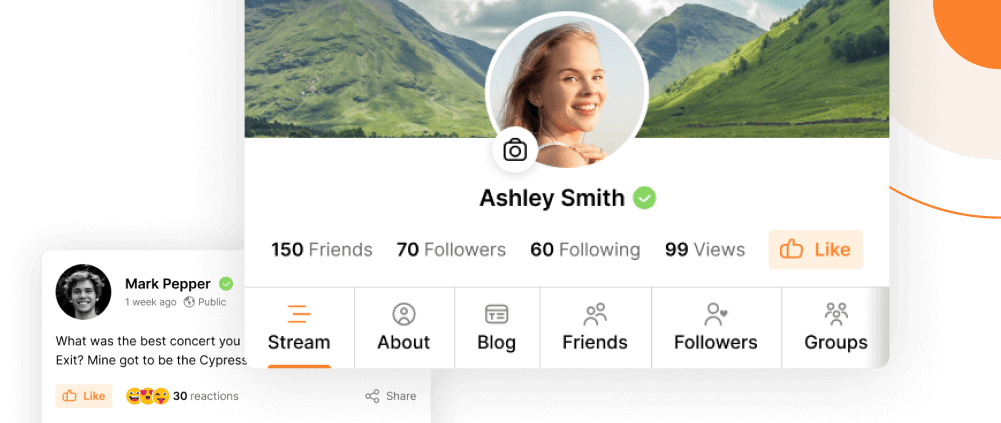
That is fine for developers. It is not ideal for site owners who want to launch. PeepSo is designed to feel more like a modern social community out of the box. Activity streams, nested comments, profile avatars and covers, reactions, groups, notifications, and media sharing are part of the experience PeepSo is trying to deliver as a product.
This is one of the biggest practical differences between the two. With BuddyPress, the admin often has to ask, “Which add-on gives me that?” With PeepSo, the better question is, “Which bundle matches the community I want to build?” That is a cleaner buying decision and a cleaner operating model.
Features: Where PeepSo Pulls Ahead
Both BuddyPress and PeepSo can support basic community features. The difference is how far you can go without stitching together a fragile stack. PeepSo includes or offers a wide set of features for modern communities:
- Activity streams for profile, group, and community posts
- Customizable member profiles with avatars and cover images
- Groups with moderation and multimedia support
- Friends and followers
- Real-time chat and messages
- Photos, albums, file uploads, audio, and video
- Live notifications
- Pages for brands, causes, organizations, teams, or public identities
- Polls, hashtags, reactions, and user blog posts
- Email digest to bring members back
- User limits and access controls
- Social login and invitations
- Stories
- Mobile app options for iOS and Android
PeepSo also goes beyond basic social networking with integrations for real community businesses. Ultimate Bundle includes integrations for tools such as WooCommerce, Dokan, Product Vendors, Easy Digital Downloads, LearnDash, Tutor LMS, MasterStudy, Paid Memberships Pro, GiveWP, WP Job Manager, WP Event Manager, myCRED, Advanced Ads, and WPAdverts.
This is where BuddyPress struggles. It can integrate with many things, but usually through third-party add-ons. That puts the burden back on the site owner to check whether each extension is current, compatible, well-supported, and visually consistent. PeepSo is simply more practical for people who want the community to be the business, not a permanent maintenance project.
Support: Community Forum vs Product Support
BuddyPress support is community-driven. That fits its open-source nature, but it also means support quality depends on volunteers, public forums, documentation, and whoever happens to know the issue. PeepSo offers support tied to active licenses. Its pricing page states that Community and Ultimate Bundles include full technical support for active license holders via support tickets. Ultimate also includes priority technical support.
That changes the risk profile. When a BuddyPress add-on conflicts with another plugin, who owns the fix? BuddyPress core? The add-on developer? The theme developer? Your freelancer? Your host?
With PeepSo, more of the core experience is owned by one product team. That does not mean every issue in a WordPress site is automatically PeepSo’s responsibility, but it does mean the main community layer has a clearer support path. For a live community, that matters.
Pricing: Free Can Become Expensive
BuddyPress is free, and that is its strongest advantage. But “free” is not the same as “low cost.” If BuddyPress gives you 60 percent of what you need, the remaining 40 percent has to come from somewhere. That might mean extra plugins, premium add-ons, custom development, extra QA, theme work, conflict troubleshooting, performance work, and ongoing maintenance.
That hidden cost is easy to underestimate.
PeepSo is more transparent. You can start with the free foundation, then PeepSo Free Bundle that includes few premium plugins and two themes. Then move into paid bundles when your community needs more. The Community Bundle covers the essentials for many smaller and mid-size communities, while Ultimate is built for communities that need the broader product and integration set.
For hobby projects, BuddyPress may still win on price. For serious communities, PeepSo often wins on total cost of ownership because it saves time, reduces plugin risk, and gives you a clearer support path.
Migration: PeepSo Makes the Switch Easier
Another point in PeepSo’s favor: it does not assume every community is starting from zero. PeepSo provides migration tools for BuddyPress, BuddyBoss, and Ultimate Member, including a BuddyPress to PeepSo migrator. That is important because many site owners have already tried the older WordPress community route and are now dealing with the consequences: outdated add-ons, inconsistent design, plugin conflicts, or a community experience that never quite feels finished.
The point is simple: choosing PeepSo does not mean abandoning the community you already built. The migrator gives BuddyPress site owners a practical way to move their existing community data into PeepSo, then continue on a platform with a more cohesive product stack and a clearer support path.
Migration tools do not magically solve every content or feature mismatch, but they reduce the friction of moving to a more modern stack. If you are already using BuddyPress and feel boxed in by the ecosystem, PeepSo gives you a practical path forward instead of forcing you to rebuild from zero.
When BuddyPress Might Still Be the Right Choice
BuddyPress can still make sense in a few cases:
- You have no budget and only need basic social features.
- You have an experienced WordPress developer maintaining the project.
- You want a framework more than a finished product.
- You are building something highly custom and accept the maintenance burden.
- You are comfortable auditing third-party add-ons before using them.
Those are real use cases. BuddyPress is not dead, and it is not without value. But those use cases are narrower than they used to be. Most community owners do not want to become plugin auditors. They do not want to test abandoned extensions against every WordPress update. They do not want to explain to members why the media plugin behaves differently from the profile plugin, or why a useful feature depends on an add-on last touched years ago.
They want to run a community. That is exactly where PeepSo is stronger.
Final Verdict: PeepSo Is the Better Choice for Serious WordPress Communities
BuddyPress helped shape the idea of a WordPress-powered community, and it still has value as a free, developer-friendly foundation. But in 2026, the better question is not “Can BuddyPress be made to work?” Of course it can. With enough time, testing, plugins, styling, and developer help, many things can be made to work.
The better question is: which platform gives you the strongest path to a modern, maintainable, member-friendly community? That answer is PeepSo.
PeepSo is better maintained, more cohesive, easier to operate, and more complete for the communities people are actually trying to build today. It avoids the biggest BuddyPress weakness: reliance on a scattered third-party ecosystem where abandoned or outdated add-ons can become part of your critical infrastructure.
If you want a free framework and you have the technical patience to manage the risk, BuddyPress is still an option. If you want a serious WordPress community with a modern user experience, active development, direct support, and a connected feature set, PeepSo is the stronger choice.
Start with PeepSo Foundation, explore the bundles, or use the BuddyPress to PeepSo migrator to move your existing community into a better-maintained stack. Your community deserves software that is still moving forward.



Reactions & comments
Comments