
Introduction
Choosing a community platform is no longer just a software decision. It is a business decision that affects your brand, your member experience, your costs, your workflow, and your long-term control over the audience you are building.
That is why the debate between Circle.so vs self-hosted community platforms matters so much. Circle promises a polished all-in-one environment with community, courses, events, payments, and branded experiences in one hosted system. Self-hosted platforms take the opposite path. They give you direct control over your site, your hosting, your WordPress stack, your integrations, and the way your community fits into the rest of your business.
For creators, membership site owners, course builders, and businesses building branded communities, the right answer depends on what you value most. If your priority is launching quickly with less technical responsibility, Circle is an attractive option. If your priority is ownership, flexibility, WordPress integration, and long-term control, self-hosting is often the stronger strategy.
In that second category, PeepSo stands out as the best practical self-hosted option for many WordPress site owners. It brings together activity streams, member profiles, groups, chat, notifications, and monetization options inside a platform you control, instead of asking you to build your business on rented space.
Why this decision matters
Your community becomes part of your business infrastructure
A community platform is not just where members talk. It becomes the place where they log in, interact, upgrade, join groups, respond to notifications, and build habits around your brand. Once that behavior is established, changing platforms later becomes harder.
That means your choice affects more than design preferences. It affects your data model, your billing flow, your onboarding, your SEO strategy, and your future flexibility. Circle supports exports, including member CSV exports and a broader community data export through support, which is useful. But a self-hosted setup usually gives you deeper day-to-day control because the platform itself lives inside your own website stack rather than inside a separate hosted service.
Cost is not only about subscription price
Circle’s current public pricing starts at $89 per month for Professional and $199 per month for Business, with additional transaction fees shown on its pricing page and some advanced options reserved for Circle Plus. That can be reasonable for some businesses, especially when convenience is the main goal. But over time, hosted platform fees, add-ons, transaction costs, and feature gating can become a serious line item.
A self-hosted model shifts the equation. You may pay for hosting, premium plugins, maintenance, and perhaps a developer when needed. But you also gain the ability to choose your own providers, optimize costs around your real needs, and keep your community closer to the rest of your website business.
What Circle.so does well
Fast launch and lower operational overhead
Circle’s biggest advantage is speed. It is built to let businesses launch a community, courses, events, discussions, and paid memberships in one managed environment. Its official pricing and platform pages highlight features such as custom branding, a website builder, analytics, rich member profiles, mobile apps, direct messaging, group chat, events, workflows, and optional branded apps.
That matters if you do not want to manage hosting, plugin compatibility, or WordPress maintenance. A hosted platform reduces the amount of infrastructure you need to think about day to day.
Strong experience for non-technical operators
Circle also appeals to teams that want a more contained product environment. There is less system-level decision making. You are not choosing hosting architecture, comparing plugin conflicts, or thinking about WordPress-specific performance tuning. For some website builders, that simplicity is worth paying for.
Circle also supports custom domains, native mobile access, desktop access, and higher-end options such as branded apps and SSO on upper tiers. Those are meaningful features for businesses that want a premium member experience without managing the underlying stack themselves.
Good fit for centralized product bundles
If your business model depends on keeping community, events, payments, and courses inside a single hosted dashboard, Circle is a clean solution. For coaches, creators, and education businesses that want an all-in-one product without much platform assembly, it makes sense.
That said, convenience is not the same thing as control.
Where self-hosted community platforms win
You own the platform environment
Self-hosted community platforms live on infrastructure you control. In a WordPress-based setup, that means your website, your hosting account, your theme, your plugins, your domain, and your database architecture are all part of one environment you manage. WordPress is open source and distributed under the GPL, which is one reason it remains such a strong foundation for businesses that want flexibility instead of platform dependence.
That ownership changes how you think about your business. You are not building a community next to your website. You are building your community into your website.
You can shape the experience around your business
With self-hosting, your community does not need to follow a preset platform model. You can connect it to your membership system, your learning tools, your store, your custom landing pages, your CRM, your SEO strategy, and your content architecture.
That is especially important for WordPress users. If your blog, sales pages, checkout flow, learning area, and member portal already live in WordPress, keeping the community in the same ecosystem reduces friction. Instead of sending users to a separate platform, you create a continuous branded experience.
Better long-term flexibility
Many website owners start by asking which platform is easier to launch. The better question is often which platform is easier to evolve.
Self-hosting gives you more room to change direction later. You can redesign the site, switch hosts, add custom development, connect new plugins, change monetization tools, or create unique member journeys without waiting for a hosted platform to expose a feature or put it on a higher plan.
That flexibility is why self-hosted communities continue to appeal to serious membership businesses, niche networks, and independent publishers.
The practical downside of self-hosting
A fair comparison needs to acknowledge the tradeoff.
Self-hosted platforms usually require more responsibility. You need to think about hosting quality, updates, backups, security, and performance. WordPress has a strong security and development process, but the site owner still needs to manage the environment properly.
For some businesses, that will feel like extra work. For others, it is a reasonable price for ownership.
The key point is this: self-hosting is not automatically harder in a bad way. It is more deliberate. You get more control because you accept more responsibility. PeepSo however, has a solution. With our Power Suite Bundle, you build a community, we make sure everything works in the background

PeepSo Power Suite

Circle.so vs self-hosted community platforms: what actually changes
Branding and platform identity
Circle supports branding, custom domains, and optional branded apps, which helps businesses present a stronger member-facing experience. But the platform is still managed on Circle’s terms, pricing structure, and feature roadmap.
A self-hosted platform goes further. Your community is part of your own web property from the start. That can matter a lot for trust, consistency, and brand value.
Data portability and control
Circle does provide exports, including member exports and broader community data export options. That is a positive sign. Still, with self-hosting you are typically working inside your own full site environment every day, which usually means more direct operational control over content structure, integrations, and site behavior.
Cost structure
Circle’s pricing is predictable at first glance, but the total cost can expand as you move into higher plans, transaction fees, add-ons, and premium features. Self-hosted setups are more modular. You assemble the stack around your goals, which can be more efficient over time for businesses that already rely on WordPress.
Integration depth
Circle offers workflows, APIs, SSO on higher plans, and other integrations. That is useful, especially for larger operators. But in WordPress, the community can sit directly inside the same environment as your content, memberships, ecommerce, and SEO pages. Circle’s API model is powerful, but it is still a bridge between systems. A self-hosted WordPress model can often remove that bridge entirely.
Why PeepSo is the strongest practical self-hosted choice
It gives you the social features people expect
A self-hosted community platform only works if it feels like a real community, not just a member directory with comments attached.
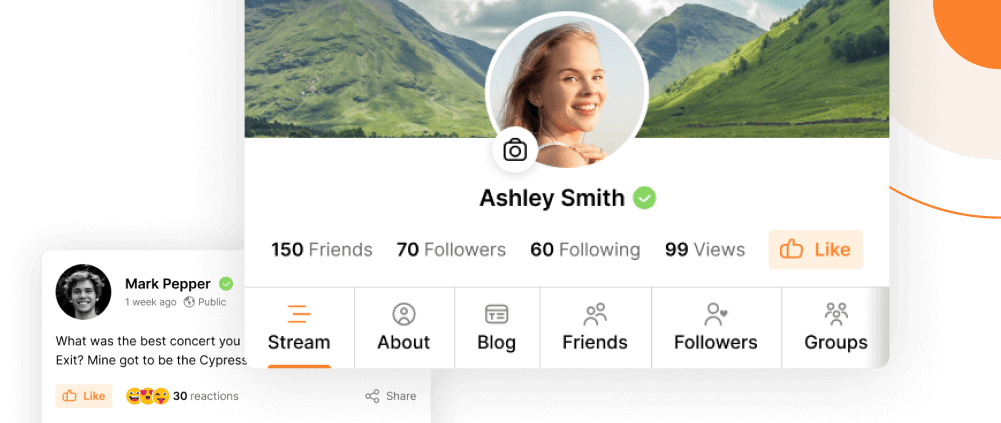
This is where PeepSo becomes especially compelling. Its official product pages position it around the features most communities actually need: member profiles, groups, activity streams, chat, notifications, and monetization options. That makes it a practical alternative not only to Circle, but also to Facebook Groups, Discord, Mighty Networks, and BuddyPress for site owners who want a branded WordPress-based community they control.
It fits naturally into WordPress
PeepSo is not trying to replace your website. It extends it.
That is a major advantage for businesses already using WordPress for content, memberships, courses, ecommerce, or lead generation. Instead of forcing your audience into a separate external platform, PeepSo lets you build a social layer directly into the site you already own.
This is often the most practical path for membership site owners and creators because it avoids a split-brand experience. Your blog, landing pages, checkout, protected content, and community can work together as one system.
It supports real member engagement, not just content access
Many businesses start with memberships or courses, then realize they need actual member interaction. PeepSo is well suited to that transition because it is built around ongoing community behavior.
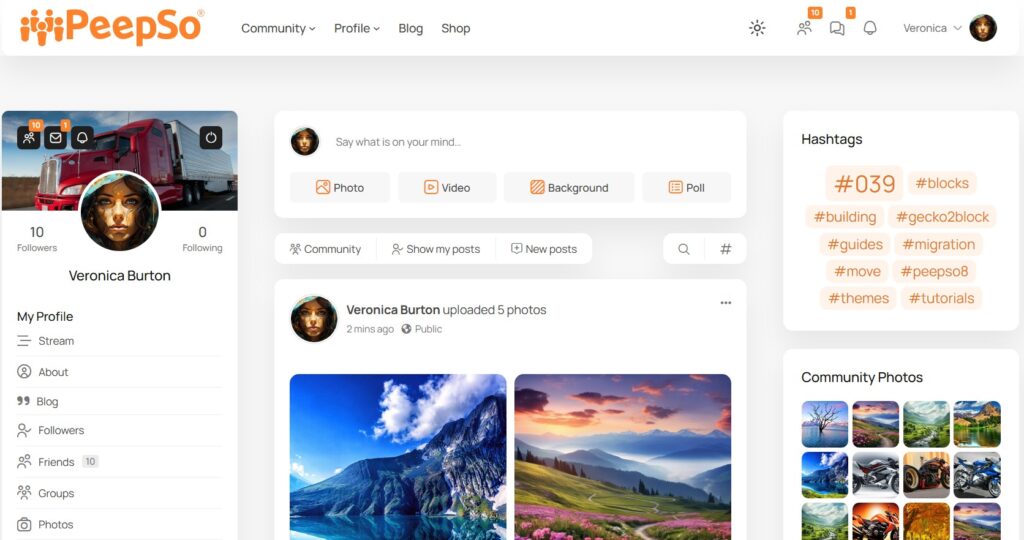
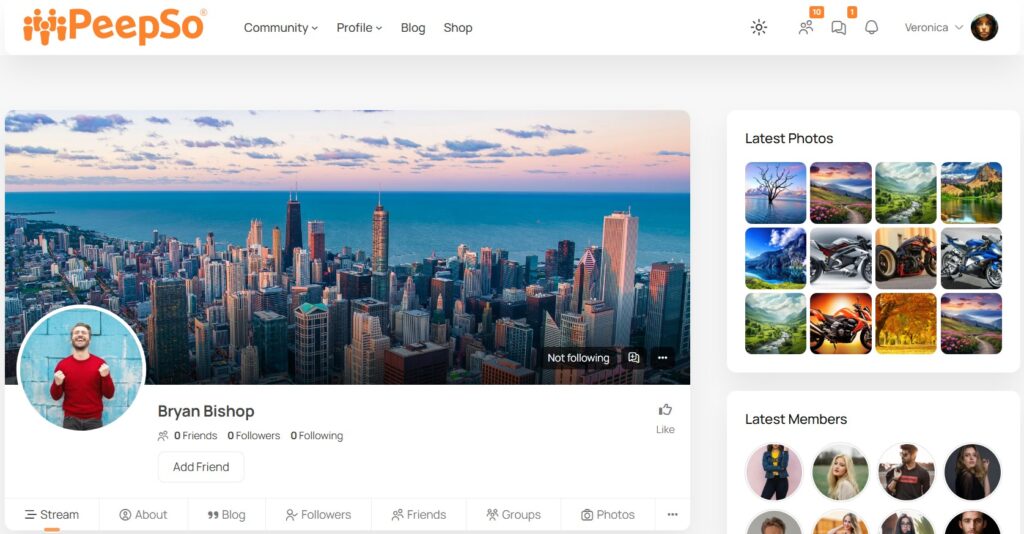
Members can have profiles. They can join groups. They can message each other. They can receive notifications. They can engage with an activity stream that feels familiar and socially intuitive. Those are the mechanics that turn a content site into a community site.
It gives you a practical on-ramp
PeepSo also offers a free Foundation version, which lowers the barrier to testing a self-hosted community before investing more deeply. Paid licenses are available for businesses that need more advanced capability and support.
That makes PeepSo a strong practical choice for businesses that want ownership without committing to an enterprise platform budget on day one.
When Circle is the better choice
Circle is the better choice when you want to move fast, reduce technical ownership, and keep community operations inside a managed hosted product.
It is a good fit when your team values setup speed over deep platform control, when you prefer paying for convenience, or when your business is comfortable operating inside a vendor-managed ecosystem.
If your main goal is to launch a polished paid community quickly with minimal platform assembly, Circle is a credible option.
When self-hosted is the better choice
Self-hosted community platforms are the better choice when your website is already central to your business and you do not want your community separated from your content, SEO, memberships, or ecommerce.
They are also better when brand ownership matters, when you want more freedom over integrations and design, and when you see the community as a long-term business asset rather than a feature inside someone else’s platform.
For WordPress users, this path becomes even more attractive. Instead of adding a disconnected community tool, you can build your own branded social layer on infrastructure you already understand.
A smart way to make the decision
If you are deciding between Circle.so and a self-hosted community platform, use this simple lens.
Choose Circle when you want convenience first.
Choose self-hosted when you want ownership first.
Then ask a second question: if you choose self-hosted, do you want to piece together multiple plugins, or do you want a purpose-built social community system inside WordPress?
For many businesses, that is where PeepSo becomes the most sensible answer. It is not just self-hosted. It is self-hosted in a way that still feels modern, social, and manageable.
Conclusion
The real difference between Circle.so and self-hosted community platforms is not just hosting style. It is the difference between renting convenience and building ownership.
Circle is strong for fast deployment, managed infrastructure, and all-in-one simplicity. It deserves consideration, especially for teams that want a polished hosted platform and are comfortable with subscription pricing and plan-based feature access.
But for website owners, creators, course builders, and membership businesses that want full control of their brand, their WordPress integration, and the long-term value of their audience, self-hosted platforms are often the better strategic choice.
And among self-hosted options, PeepSo is the best practical solution because it combines the community features people actually use, such as activity streams, member profiles, messaging, groups, and notifications, with the ownership and flexibility of WordPress. That makes it a stronger long-term foundation for businesses that want a real community platform on infrastructure they control.


Reactions & comments
Comments